Personal and Collective Morality. (Morality 5)

I assert that morality, the internal compass for right and wrong, is personal. It cannot be a shared or be community standard simply because we all have different priorities, and those priorities change from day to day with our lives. When I was a teenager, I had questionable and flexible moral standards. As I grew, became a man and assumed adult responsibilities, my internal compass changed. Get married, quit chasing random women. A father, well, there go most of the toys and self-indulgent hobbies. Personal priorities are a constantly shifting patchwork and cannot be shared with the whole community.

Collective morality is a myth, or at least a mislabeling of an observed standard of conduct. If morality is internalized than community standards are ethical, external standards, enforced either by community disapproval or codified as law and punishable as such. Any conduct that is forced or enforced cannot be moral, there is no choice other than obedience or punishment. The act is simply avoidance of punishment or defiance.

There is a tendency of communities of similar standards to raise children to reflect their beliefs and standards of conduct. Christians raise their children, with varied success, to whatever standards are derived from their version of Christianity. Jews, the same, depending on their sect, or Islam. Living in the northeast, I have the handy example of the Amish. A strict sect that will expel anyone who violates the precepts of their faith and community. What the children learn from their community is what will become their internalized moral standard. It is impossible for everyone to share the same world view and priorities. If nothing else is applied, the perceived rank within a family is different Father, mother, children by age and talent.

At best, the collective standard can be the mores, customs and conventions that when viewed externally, can roughly define what a community believes. Further division occurs in different communities or subcultures. What comparisons can be made between urban and suburban cultures; nations differ significantly as well. Is there a universal standard for good and evil? Is it possible to achieve a single standard when there are cultures that believe everyone who does not share their beliefs is wrong and somehow lesser? Sadly, the answer is no. As long as one group rejects the foundational beliefs of equality, a universal definition of good and evil will be impossible.

In “Famine, affluence and morality”, (Singer 1974), Singer argues that it is a moral requirement to send any excess funds to support charities. The argument is based on an equivalence argument that breaks down once past the benefactor/recipient stage. If you send your funds as food support to an obscure African village, the chances are fairly high that the local strongman will benefit more than the intended recipient. Singer simply created a logic box and excludes the reality of his proposition. If we shift our perspective along the layers of interaction, the different moral and ethical standards are obvious

The affluent feel obligated to provide for those less fortunate, either from altruism or self-aggrandizement. Starting from the doner, the desire to donate excess funds, an obvious first world problem, comes from a need for recognition.
Morality (4) Evil.

Seems like an easy one. Evil is evil, right? Wait, was that circular? Damn.

If we define it as a noun, instead of an adjective or adverb, it will make it easier. Is it suffering, misfortune or intentional wrongdoing? Does it count if your feelings are hurt because you interpreted what I was doing as mean? Suffering is definitively subjective and personal. I have a harder time suffering fools than broken bones. Misfortune is part of most lives, so also not important to the discussion. Your feelings are on you, not me. Baring a cosmic entity of evil, “the Devil”, we are left with intentional wrongdoing to cause harm.

Dictionaries have changed the definition over the years, but the base stays the same. Strangely, it also gets more complex over the years. our web of concern expands.

evil (noun) moral depravity; injury; affliction. (Webster Peerless Office, Home and School. 1939)

evil (noun) · evils (plural noun) (Bing online Dictionary, reference to Oxford Languages, 2024)

(1) profound immorality and wickedness, especially when regarded as a supernatural force.

Similar: wickedness, a badness, wrongdoing, sinful, ungodliness, immorality, vice, inequity, turpitude, degeneracy, vileness, baseness, perversion, corruption, depravity, villainy, nefariousness, atrocity, malevolence, devilishness, peccability. Opposite: goodness

(2) a manifestation of profound immorality and wickedness, especially in people’s actions.

Similar: abomination, atrocity, obscenity, outrage Opposite: blessing

(3) something which is harmful or undesirable.

Similar: harm, pain, hurt, misery, sorrow, suffering Opposite: benefits

I think we need to emphasize the intentional part of this. An act done with the intent of providing good service or positive outcomes, that doesn’t meet expectations is not necessarily evil. An evil act is like a premeditated crime, it is carried out with forethought and intent. There isn’t much doubt that the act is wrong and evil as a label just indicates a level of wrongdoing beyond normal expectations, heinous in nature. I like the word heinous, here. It fits well and sets edges to the discussion.

Not everything is going to qualify as evil, not many actions are inherently good or evil in and of themselves. Sex is useful as an example. For most people, sex is just a pleasant act between two people. So, lets change that. What does your religion have to say about it? Anything? What about two men or two women? Instead of two consenting adults, let’s make it one forcing and the other unwilling, rape. Is it bad? How about an adult and a child? An adult forcing a child? An adult enticing a child? That’s the spectrum from something that we barely think about to something that makes most of us a little angry.

It gets a little blurry when we start trying to apply the idea of evil to society. There are so many perspectives that knowing right and wrong becomes difficult. What one group considers good is a sin to another, like alcohol. Is the manufacture, sale and consumption of alcohol good or evil in itself? Does the type matter? Again, what does your religion tell you? Is evil, defined by religion or can it be defined in another way?

Morality is personal. It is impossible to have collective morality. That is not to say that a group cannot have an aggregate of beliefs and actions that can be classified as good or evil. So, now we have two more categories to contend with, personal and collective morality.

What fun!

Morality (3) Wrong and Evil.

I noticed that I skipped over trying to define what wrong and evil are. Those are tough words, complicated by degree. How wrong? How evil? Where and how do we draw the lines?

I was going to take the easy way out and say that wrong is something that causes harm to another. That is simplistic and indefensible. In war, law enforcement, medicine, or any situation where a decision needs to be made and you can likely come up with a way that someone may be harmed. We can also skip for the time being, the numerical arguments that are based on the “Greater Good” or “Greater Harm”. Triage is triage, making decisions based on economics, in the classical sense not financial. There are only so many lifeboats or X- number of doctors for Y-patients. You can use the resources wisely and save the people with the highest chance of survival or waste it trying to achieve an equal outcome for all, in which case is probably death.

That leaves the other two sides, moral good and societal good.

Moral good is inwardly focused but outwardly observed, virtue based on a particular creed that dictates actions. It also seems responsible for the Patriarchy, men leading, working, fighting and sacrificing for women and children. Also, those who took the rights of patriarchy more seriously than the obligations. Witness the scale – in the former we can see virtue in a man who sacrifices for his family or community. In the later someone who may contribute to the family or community, but lacks virtue because, inwardly his actions are directed by self-interest. The simple definitions do not take into account things like an abusive or unfaithful spouse, emotional trauma or exhaustion, financial strains that seem insurmountable, just virtue and evil.

Societal good is even trickier. What constitutes good for a society? How do we measure it. This question is answered in ethics, the outward actions of individuals, whether they are people, communities, corporations or governments. Whose self-interest is the deciding value? Peter Singer brings this up in an offhand way in “Famine, Affluence and Morality”, an essay he wrote in the 1970’s, arguing that it is immoral to spend money on luxuries when there are people suffering that can be helped by financial support. Failure to do so, is by Singer’s argument, evil. I’m not convinced, a logic box is a logic box. Solipsism is a fine argument to waste time on, but it’s just a logic box, it is true by the parameters placed around it.

Center stage in America is the Trans debate, exclaiming that it is good and essential to acknowledge and support anyone who feels that they are closer to being identified as a sex not supported by their biology. They would be happier if they could simply transition, emerge from the cocoon of hormones and surgeries to be what they believe they are. The next step is to support the beliefs of minor children if they believe or are convinced that they are Trans. With children, it becomes more difficult, do we allow half-formed minds to determine their future because we believe they truly know themselves? When I was a child, I believed I was a fireman and a police officer. Should I have been given a gun or allowed to run into burning buildings to support my belief? We have laws preventing anyone under 18 from getting tattoos, but they are allowed to castrate themselves because they believe it will make them happy?

What about the harm or risk to others. Mixing biological sexes in ways that thousands of years of societies have avoided such as bathrooms, mixed changing rooms, letting boys and girls share a room on a trip because one claims to be Trans. Why do we neglect protecting children because they believe they have a right to make decisions that are beyond their experience?

Another view? Is it ethical to allow the government to take extraordinary measures to save Social Security for the Baby Boomers? There is no way to do this without imposing on the still working Gen-X and Gen X groups, who will have to rely on the Millennials and whoever is next. The program is insolvent for simple reasons. When it was started, the expectation was that it would provide additional income for a limited amount of people for a short period. The average life expectancy in the 1930s was 58 for men and 62 for women, so most would not have reached the age of 65 to receive payments. In 2017, those numbers had risen to 77 for men and 82 for women. On average, most Americans will live to collect a portion of benefits for up to 12 years, when the original program did not foresee many receiving any benefits. Would it be ethical to reduce the benefits paid instead of passing the burden to the next generation.

Of course, we haven’t touched on Medicare and Medicaid. Heroic measures for life saving interventions for the elderly who are simply waiting to die and served by machines. Estates and lives crushed under the cost of paying for health care that cannot restore health and does not care for the welfare of the patient or families.

So, evil…

How do we decide what is moral? (Morals 2)

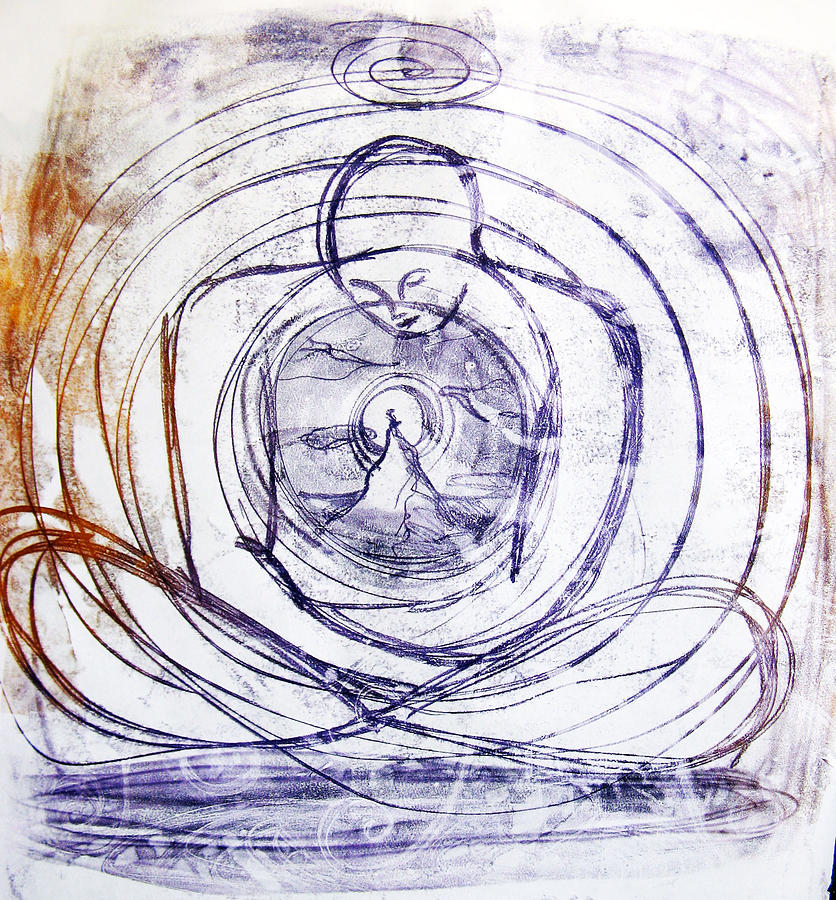
This beautiful piece is “Inward Focus”. I guess people with real talent don’t need a lot of words to impress others. https://fineartamerica.com/featured/inward-focus-khara-scott-bey.html

It’s an interesting question. How do we decide if something is or is not moral? There is obviously a varying standard, or it wouldn’t be a difficult question.

If we look at modern society, we can see the variety in religion, sexual variances, drug and alcohol use, marriage rights and childrearing. Even within religions, the differences are fairly significant. Abrahamic religions have 2 major sects in Judaism and Islam, with Father Abraham being coopted by the rest of Christianity. Catholicism has over 20 branches, and half a dozen rights, then there are Lutheran, and the Church of England. Protestant branches look like a kudzu vine in a windstorm. At the base, all of these belief systems, should have the same moral standards.

I have assumed that communities or societies mores are based primarily on the standard religious beliefs of the majority of the people. The variations seen in communities where religions are intermixed are understood by accommodations mutually agreed upon by them. Through growing up exposed to these ideals, a child internalizes the standards (or not) and bases his conduct on those standards. That’s where we get the sense of right and wrong, good and evil. The expression of morality is how an individuals conduct effects those around them.

As I was writing this, it occurred to me that there are societies and subcultures that aren’t influenced by or have rejected religious belief systems. Those that I have encountered were reduced to survival or subsistence, where good and evil could be defined as living and dying. At a survival level, the only good is what benefits me, and another’s value is determined by their contribution to my survival. If you work your way up through the family and community to a societal level, it will probably create an insular society.

I have a question of Morals. (Morals 1)

I believe that the solution depends not on the definition, since both morals and ethics are interested in good and right conduct, but the focus of those standards. The easiest answer seems to be that morality is an internally focused set of standards, controlling what/why we act a certain way. We think of people with a moral compass and high or low moral standards. The quality may be judged by an external standard, but it is still internally focused.

Ethical conduct is the judgement of how good or fair our interaction with others is. The usage of the word is a strong indicator, ethics in the workplace or ethical conduct towards others, how do we treat others, based on a set of rules. As our society grows, it also seems that ethical conduct is judged legalistically, as opposed to morally.

The recent case of former President Trump, being charged civilly for an act that didn’t cause harm, reeks of unethical conduct. The case was not the result of criminality or complaint but appears to be nothing more than an attempt to keep a disagreeable person from becoming president again. Did the Judge act ethically to protect people from a perceived threat? Or was it simply an immoral act and abuse of power?

As tentative answers, I would like to suggest very simple definitions.

Morality – an internalized standard of conduct, normally propagated through society and religion.

Ethics – a legalistic and externally focused standard of conduct, judged by interactions.

Good – the amount of benefit or joy produced by an action.

Right – A correct action taken without reference to the benefit produced.